
A three-hour interactive workshop for real estate operators, sponsors, and fund managers who want to reposition the deals they already do around after-tax returns, and raise private capital at scale.
Private wealth does not buy IRR. It buys tax benefits.
Institutional real estate fundraising is having its worst stretch in nearly a decade. Private real estate funds closed on $92.6 billion in the first half of 2026, down 38% year over year and the weakest first half since 2017. Over the same stretch, Delaware Statutory Trust sponsors raised $8.41 billion in 2025, up 49% from the prior year, and Mountain Dell Consulting projects $10 to $11 billion for 2026. Same asset class, opposite direction. The difference is not performance. It is who the product was built for.
Individual investors hold roughly $150 trillion of the world's $290 trillion in wealth and put about 5% of it into alternatives, while institutions account for 84% of global alternatives investment. Pensions and endowments pay no tax, so they underwrite IRR and multiple. Family offices, RIA clients, and high-net-worth individuals pay 40% to 54% on ordinary income depending on the state, and their first question is not what a deal earns; it is what survives the return.
A 20% pre-tax IRR with a taxable exit loses to a 12% deal with a tax deferral story, and most sponsors have never run the comparison that shows it.
Real estate is the only major private asset class that manufactures both reduction and deferral out of ordinary operations. Depreciation, cost segregation, like-kind exchange, and Opportunity Zone treatment are not exotic add-ons reserved for DST sponsors and zone specialists. They sit inside almost every deal already on the books, and most operators give them away in a footnote instead of pricing them.
This workshop is about putting a different wrapper on the same underlying business: understanding the wrapper options, structuring a fund or a project-level investment to carry them, and marketing the result to the investors who will pay a premium for it. Justin Petersen, Angela Brown, and Paul Stanton teach the structuring side and the capital-raising side together, because in practice the two decisions get made at the same table.


Angela helps execute the tax strategy of private markets managers. She was previously Head of Tax for a vertically integrated real estate investment manager with $3 billion of equity under management, where she led tax planning, structuring, forecasting, and reporting across the firm's investment vehicles, with particular depth in Qualified Opportunity Zone structuring. Earlier she was a Senior Tax Manager at Aprio, where she led the firm's Qualified Opportunity Zone practice, and began her career at PricewaterhouseCoopers in the financial services group, specializing in real estate. She holds a BS in Accountancy and a Master of Taxation from the University of Illinois Urbana-Champaign, is a licensed CPA in Illinois, and co-authored the Practitioner's Guide to Tax Alpha.
Contact the host →
Justin builds the operating infrastructure behind private markets managers. He was previously CFO of a real estate investment manager overseeing $3 billion in equity, where he executed more than $4 billion of transaction volume and ran finance, accounting, tax, risk, IT, and HR. Before that he was VP of Finance and Legal at Farmers Fridge through a 5x revenue run, and a corporate attorney at Sidley Austin on $7.5 billion+ of capital markets and structuring transactions. He holds a JD (Order of the Coif) and an MBA from the University of Iowa, and co-authored the Practitioner's Guide to Tax Alpha.
Contact the host →
Paul is also a partner at PTB, a real estate investment banking boutique, and focuses on the intersection of capital markets, media, and alternative real estate. He has funded over $1B of real estate projects and platforms, and acquired and asset-managed over 8 million square feet of office, industrial, and multifamily assets in the US.
Contact the host →You'll learn how to
Size the opportunity honestly
Where private wealth capital actually sits, how it differs from the institutional pool most sponsors have been chasing, and why tax treatment is the edge real estate has that private credit and public equities cannot copy.
Speak in tax-adjusted returns
One simple equation with four numbers: net-of-fees return, fully taxed return, after-tax return, and tax-adjusted return. Tax alpha is the gap. The math is arithmetic, not tax law.
Know the full wrapper menu
Bonus depreciation, cost segregation, 1031 exchanges, DSTs, Qualified Opportunity Funds, UPREIT exits, and basis step-ups, explained plainly enough to hand to a non-real-estate LP.
Structure the vehicle for the wrapper
Fund versus deal-by-deal, entity and debt choices that size the first-year shield, exit paths committed at underwriting, and the reporting infrastructure that makes tax-driven product sellable.
Present tax alpha credibly
How to disclose assumptions so a projected after-tax number earns trust instead of reading as marketing, and where the antifraud and equal-prominence lines sit.
Distribute at scale
Turning the analysis into a white paper, a webinar series, a newsletter, and a CPA and wealth-advisor referral channel that produces inbound instead of one-off conversations.
Attendees leave with a working model of their own deal's after-tax return, the wrapper options that fit it, and the outline of the campaign that sells it.
What the workshop covers
The Private Capital Opportunity
- Why institutional real estate fundraising fell to a nine-year low while tax-advantaged retail product set records in the same market
- Individual investors hold roughly $150 trillion of $290 trillion in global wealth and allocate about 5% to alternatives; institutions account for 84% of alternatives investment today
- What a taxable investor actually optimizes for, and the arithmetic that makes a lower-IRR deal the better buy
- The channels that buy tax treatment: single-family offices, multi-family offices, RIAs, CPA and wealth-advisor referral networks, and the broker-dealer channel that moves DST product
- Why this is not a DST-and-Opportunity-Zone conversation; conventional value-add, development, and single-asset deals carry the same levers
The Math, Explained Simply
- The four returns every taxable investor needs, and how they relate: net-of-fees, fully taxed, after-tax (ATR), and tax-adjusted (TAR). Tax alpha is TAR minus net-of-fees
- Live walkthrough of a $2.5 million equity position in a $5 million multifamily deal, from an 11.1% net-of-fees return to a 20.5% tax-adjusted return
- The ladder, layer by layer: regular depreciation adds 1.1 points, cost segregation and bonus add 2.6, the 1031 exchange at exit adds 5.7
- Why gain deferrals do more work than depreciation, and why accelerating depreciation without an exit plan mostly relocates the tax bill through recapture
- Section 469 and the passive activity rules, and how to test it before crediting a first-year shield
- Sensitivity: the same deal produces 9.4 points of tax alpha or 1.4, depending on two variables
The Wrapper Menu
- Bonus depreciation and cost segregation: 100% first-year expensing made permanent for property placed in service after January 19, 2025
- Section 1031 exchanges: the deferral engine, what the business plan has to support for it to be real, and what it costs in flexibility
- Delaware Statutory Trusts: 50 active sponsors and 89 programs raising $8.41 billion in 2025, what it takes to become one, and the Section 721 UPREIT exit
- Qualified Opportunity Zones after OBBBA: permanent program, new zone map effective January 1, 2027, rolling five-year deferral, 10% basis step-up, 30% for rural funds, and how to play the window before the new designations land
- Where QSBS, basis step-ups, and operating-company treatment apply to real estate platforms and management companies
- What each wrapper costs in fees, flexibility, reporting burden, and operational lift, with the cases where the honest answer is to keep presenting pre-tax
Structuring the Vehicle Around the Wrapper
- Fund, deal-by-deal, or programmatic: which wrappers survive which format
- Entity choice, basis, and how leverage concentrates first-year depreciation against fewer equity dollars
- Committing the exit path at underwriting instead of improvising it at sale
- Investor-level suitability: modeling the passive or non-passive status of the LPs actually in the deal rather than a hypothetical one
- The infrastructure that makes tax-driven product sellable at scale: K-1 timing, cost segregation study economics, fund administration, custodian compatibility, and after-tax reporting
- How the distribution channel decides the cap table, and what IRAs, passive-only LPs, and DSTs each force the structure to do
- What the tax advisor needs to review, and why it has to happen going in rather than at closing
Marketing the Tax Alpha
- Lead with the assumption, not the result: "20.5% tax-adjusted, assuming a 1031 exchange at exit and a usable first-year loss" earns trust, while a bare number reads as marketing
- Equal prominence in practice: presenting tax-adjusted returns alongside net-of-fees without crossing the antifraud rules that govern investment marketing
- Building the after-tax page in the deck, the tax alpha ladder chart, and the one-page investor summary
- Translating the analysis for an LP who has never owned real estate, in the language their CPA already uses
- Teardown of a real white paper, Ars Bellica's Practitioner's Guide to Tax Alpha, as a worked example of education that sells
Distribution at Scale
- The content engine as a sequence rather than a scatter: white paper, webinar, newsletter, and social, each feeding the next
- Why CPAs and wealth advisors are the highest-leverage channel for tax-driven product, and how to earn shelf space with people who are paid to be skeptical
- Webinar and seminar formats that convert, and the case for co-hosting with a tax professional rather than presenting alone
- Building the list: where these investors surface, what triggers an inbound, and how a liquidity event changes the conversation
- Timing campaigns to the tax calendar, which is the one deadline this audience cannot move
What Goes Wrong
- Negative tax alpha: structures that convert capital gain into ordinary income or throw off heavy taxable distributions leave investors worse off than a plain deal
- Underwriting an exchange the business plan will never support
- Promising a first-year shield to passive LPs who cannot use it, and what happens when the K-1 arrives
- Tracking realized after-tax returns against what was underwritten, at both the deal and portfolio level
- Where the tax-exempt and retirement capital in the cap table changes the analysis, including UBTI on leveraged deals
The equation, in one table
Every claim in the workshop reduces to this comparison, run on a single set of cash flows. A $2.5 million equity investment in a $5 million multifamily property, half financed, five-year hold, taxable investor at top federal and California rates.
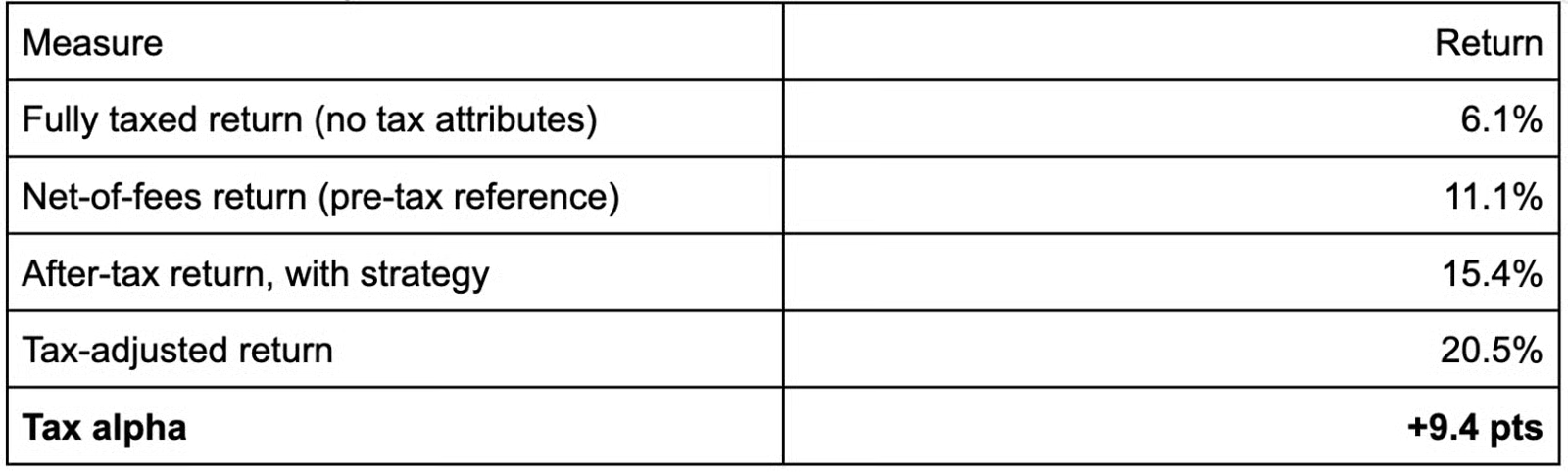
Same deal. Same pre-tax return. The spread between what one investor keeps and what another keeps is entirely a function of structure, and it is the number this audience is actually shopping.
Who this is for
Real estate operators, sponsors, emerging managers, and fund managers who have been raising on IRR and want a second value proposition for taxable capital. Also relevant for capital markets advisors, placement agents, family office principals, and the CPAs and wealth advisors who sit on the other side of these conversations.
No prior experience with DSTs, Opportunity Zones, or cost segregation is assumed, and none of it is required to benefit. The wrappers covered here apply to ordinary value-add, development, and single-asset deals, not just to specialist product. The math is arithmetic; the tax law gets explained in plain English for both GPs and LPs who do not do this for a living.
Format & access
One live session
Three hours in one day, including the live modeling exercise and Q&A with both instructors.
A recording for everyone
Recordings are sent to all registered attendees, whether or not they attend live.
Slides & materials
Participants receive the slides, the four-return model template, the ten-point deal diagnostic, and the Practitioner's Guide to Tax Alpha.
Ongoing access
Recording, slides, and materials stay in your Thesis Driven account, ready whenever you need them.
Frequently asked questions
Do I need to be doing DSTs or Opportunity Zone deals for this to be useful?
No. Those are two wrappers on a longer menu, and they get covered because they are the most misunderstood. The levers that produce most tax alpha, depreciation timing and deferral at exit, sit inside conventional value-add, development, and single-asset deals that most attendees are already running.
Is this a tax course?
It is a capital raising workshop that happens to require some tax literacy. The math is arithmetic on cash flows the deal team already models. The tax law gets explained in plain English, at the level needed to structure a deal and talk to an LP, not at the level needed to file a return. Nothing here substitutes for advice from qualified tax counsel.
Will participants receive a copy of the materials?
Yes. All registrants receive the slides, the model template, the diagnostic checklist, and the supporting white paper, stored permanently in their Thesis Driven account.
I can't make this time, will a recording be available?
Yes. The recording goes to every registered attendee regardless of live attendance, along with all workshop materials.
I'm an LP or an advisor rather than a sponsor. Is this relevant?
Yes. The same four-return framework is what an allocator uses to pressure-test a sponsor's after-tax claims, and Module 08 covers the failure modes on the diligence side.
Hear from our alumni
"Brad and Paul opened my eyes to how real estate deals get put together, where incentives lie, and how we might create business cases for proptech and climate tech. Great stuff!"
"A perfect introduction to the most important real estate concepts, distilled down in the perfect way to absorb and retain. Paul and Brad clearly thought a lot about how to actually educate, not just data-dump the group."
"Excellent course that guides you through a fictional case study with detailed explanation of every single step for all personas at every stage of a real estate deal. I highly recommend enrolling."
"Huge thank you for an amazing five weeks. The 'Selling into Real Estate Owners' course content is a goldmine for anyone building or selling in PropTech, and the weekly cohort discussions are a rare chance to learn directly from peers."
"A collection of engaging and collaborative sessions on how to launch and structure a venture into real estate. Paul and Brad put on a great class with an even better collection of participants."
As featured in








Raising Private Capital with Tax Alpha
Live on Tuesday, October 20, 12-3pm Eastern Time. $399.
Register for this workshopRecordings are sent to all registered attendees, whether or not you attend live.