
Real Estate Letter of Intent (LOI): An Operator’s Playbook (2026)
The handshake costs nothing. The LOI starts the deposit clock. A 2026 operator's playbook for purchase and lease LOIs.
SHARE
A real estate letter of intent (LOI) is the short, mostly non-binding document that outlines the major terms of a deal before the formal contract. In a purchase, it precedes the Purchase and Sale Agreement (PSA) that triggers the soft deposit. In a commercial lease, it sets base rent, tenant improvement (TI) allowance, term, and escalations before the lease itself. A handful of clauses bind even inside a “non-binding” LOI: confidentiality, exclusivity, and governing law. The LOI is where the deal gets structured; the contract just signs the structure.
The handshake costs nothing; the LOI starts the deposit clock.
Operators who treat the LOI as a formality pay for it in subsequent negotiations. Purchase price, deposit structure, due diligence window, exclusivity, and timeline to close all get set here, and those terms become the baseline for every contract round that follows.
What is a letter of intent in real estate?
A real estate letter of intent is a short document, one to three pages, that outlines the principal terms of a proposed deal before the parties sign a formal contract. On the purchase side, the LOI precedes the Purchase and Sale Agreement (PSA). On the lease side, it precedes the lease itself.
The LOI sits between the handshake and the contract, forcing both sides to commit the deal outline to paper and surfacing misalignments that would otherwise only emerge during contract drafting. It also becomes the artifact operators take back to lenders and equity partners to convert soft commits into hard capital, a mechanic Paul Stanton, partner at Thesis Driven, details in Build Your Real Estate Capital Raising Plan.
LOIs are sometimes called letters of interest, term sheets, or memoranda of understanding. In real estate, “letter of intent” and “LOI” are the dominant terms.
Is a letter of intent legally binding?
Short answer: mostly no, with specific exceptions that matter a lot.
The core economic terms (purchase price, rent, deposit, closing date) are typically non-binding. Either party can walk, revise, or refuse to sign the subsequent PSA or lease. LOIs routinely state “non-binding” on the first page, following general contract law principles.
Three clauses bind even inside a “non-binding” LOI:
- Confidentiality. Both sides agree not to disclose the deal terms or each other’s proprietary information. This binds even if the deal falls apart.
- Exclusivity (no-shop). The seller or landlord agrees not to negotiate with other parties for a defined window, 30 to 90 days. Breaching exclusivity is a real, enforceable claim.
- Governing law and jurisdiction. Which state’s law applies and where disputes get heard. Binding because it dictates how the rest of the document is interpreted if a dispute arises.
Some LOIs add binding provisions on good-faith negotiation or expense reimbursement. The binding section sits at the back, labeled as such.
What goes in a real estate letter of intent
The structure changes by deal type, but most LOIs share a core set of elements:
- Parties. Buyer/tenant and seller/landlord, with proper legal entities.
- Property. Physical address, parcel ID, and a description of what’s being transacted.
- Headline economics. Purchase price (for a sale) or base rent and term (for a lease).
- Deposits and earnest money. Amount, refundability, and what triggers forfeiture.
- Timeline. Due diligence period, closing or lease commencement date, milestones.
- Contingencies. Financing, inspection, environmental, zoning, title.
- Exclusivity window. How long the seller or landlord agrees not to shop the deal.
- Expiration. The LOI has a 30-day shelf life from signing, sometimes shorter.
- Binding provisions. The clauses that survive non-signature (confidentiality, exclusivity, governing law).
A purchase LOI adds financing contingency, inspection scope, and a 30 to 60 day due diligence window. A lease LOI adds tenant improvement (TI) allowance, escalations, operating expense structure, and renewal options.
Three of those items absorb most of the negotiation, and they trade against each other. A seller pushing for a larger non-refundable deposit will usually concede a longer due diligence window, and a buyer who wants ninety days of diligence should expect to pay for it by going hard on the deposit earlier. Exclusivity is the third lever: a seller granting sixty days off-market is taking real risk, and the price of that is normally a deposit that stops being refundable before diligence ends.
The binding provisions are where a non-binding document does real damage. An LOI that calls itself non-binding in one clause and then obliges the buyer to keep information confidential for two years is both, and the drafting that prevents an argument later is an explicit list naming which numbered paragraphs survive and which do not. Confidentiality, exclusivity, governing law, and any expense-reimbursement clause belong on that list. Everything else should read as an intention.
The more common mistake runs the other way, toward over-specification. An LOI that tries to pre-draft representations, warranties, and indemnities stops being a one-page alignment document and becomes a contract negotiation without any of the protections of a contract. The job is to fix structure, price, timeline, and the handful of terms that would kill the deal if they surfaced late. The contract does the rest.
Purchase LOI: where it sits in the deal cycle
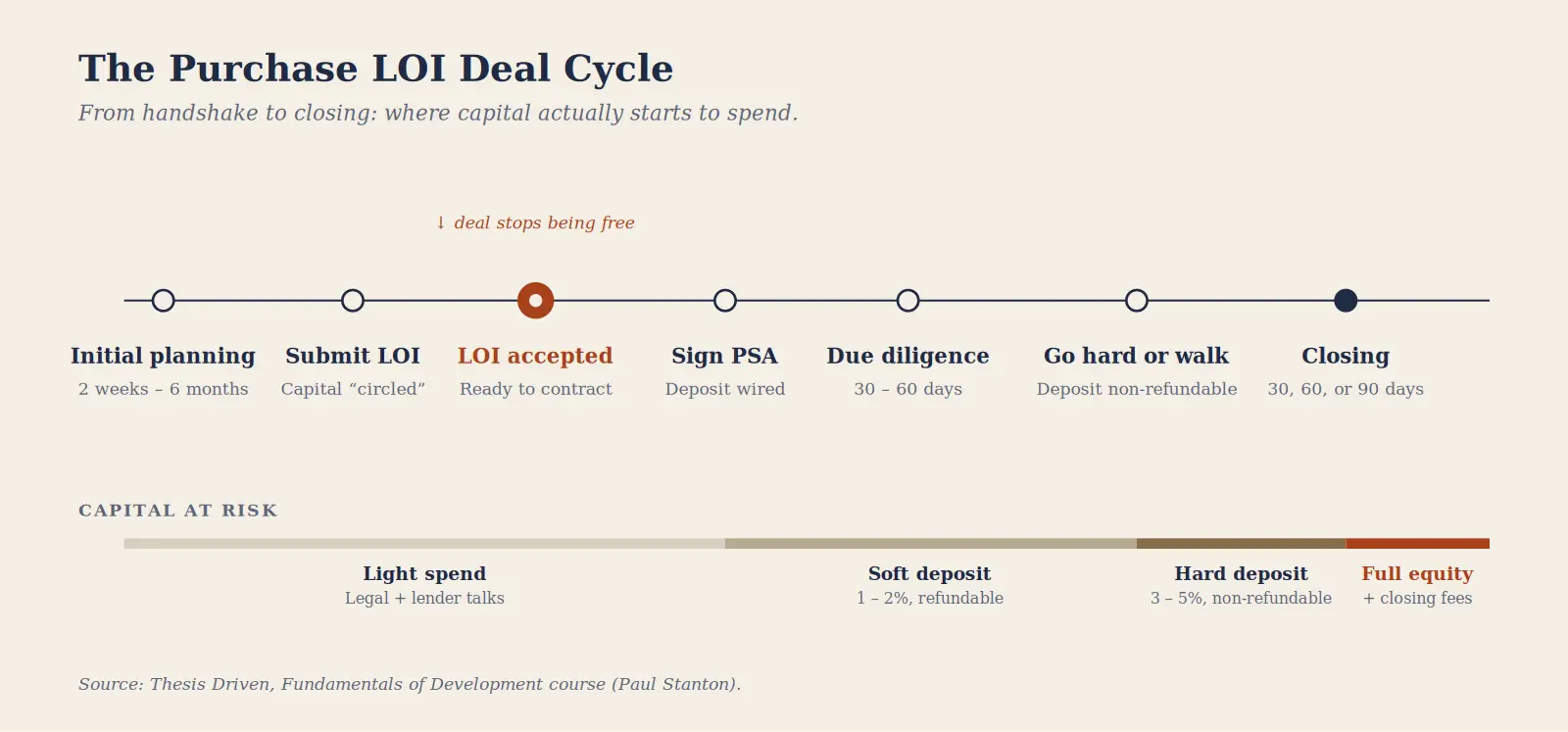
The purchase letter of intent is the flip point where the sponsor stops optioning the deal for free and starts spending real money. The sequence:
- Initial planning (two weeks to six months). Underwriting, lender conversations, early investor meetings. Light spend.
- Submit LOI once capital is “circled.” That means a debt term sheet plus soft commits from lead investors.
- LOI accepted. The seller signals readiness to contract.
- Sign PSA and wire the soft deposit, 1% to 2% of the purchase price. Refundable during due diligence.
- Due diligence of 30 to 60 days. Inspections, surveys, legal review, financing.
- Go hard or walk. Walking returns the soft deposit. Going hard converts the deposit (3% to 5% of the purchase price) to non-refundable.
- Closing 30, 60, or 90 days after going hard. Full equity, legal fees, loan origination.
The most-negotiated items in a purchase LOI are purchase price, due diligence length, and the hard-deposit trigger. Sponsors want longer DD and smaller, later-triggered hard deposits; sellers want the opposite. The outcome depends on market tone and which side has optionality. Pre-development costs (legal, surveys, environmental, engineering) have their own funding question, covered in TD’s Funding Pre-Development Costs.
The purchase price should be the output of underwriting, not the seller’s ask. Brad Hargreaves, Thesis Driven founder, on the discipline in TD’s Real Estate Finance 101 workshop:
“The purchase price actually becomes the output of this underwriting, because if the deal doesn’t make sense at that price, we can use this exact same math to back into the price we’re willing to pay.”
Every LOI references pro forma assumptions tied to the deal. Purchase price, rent growth, and exit cap should all be defensible before the document gets signed.
The other layer of pricing discipline: list price is rarely deal price. Most listings carry a whisper price, the number a broker quietly signals the seller would actually accept. If the listing is $65M but the whisper is $60M, the LOI starts at the underwriting-defended number, not the listing. Operators who submit at list price are signaling they don’t know how commercial real estate is priced.
Lease LOI: what operators actually negotiate
A commercial lease letter of intent has more moving parts than a purchase LOI. The most-negotiated levers beyond base rent and term:
Tenant improvement (TI) allowance
Money the landlord contributes to the tenant’s build-out, quoted per square foot. Paul’s rule of thumb: $5 to $10 per square foot per year of lease term. A 10-year lease at $7/sq ft/yr yields a $70/sq ft TI package; a 2-year lease at the same rate yields $10 to $20/sq ft, barely enough to move the needle. The asymmetry is intentional. TI is how landlords incentivize longer leases, because the resulting cash flow stream compounds when the building is later sold.
Rent escalations
How base rent grows year over year. The two dominant structures are a fixed annual bump (commonly 3%) or a tie to the BLS Consumer Price Index (CPI). CPI is the win-both-ways option: tenants get increases tied to a transparent index, landlords get inflation protection. Step increases at specific year intervals are a third option used in longer leases.
Percentage rent (retail only)
On top of base rent, the tenant pays a percentage of gross sales above a threshold. A common structure: 5% of gross sales above $1M annually. Landlords use this when they believe the tenant will overperform. A ramp-up period (no percentage rent for the first six months) is a tenant concession that gives the operator time to build sales.
Operating expenses, often called CAM (common area maintenance)
The tenant’s pro-rata share of taxes, insurance, and CAM costs. In triple-net leases the tenant covers these in full; modified gross caps the exposure; full-service gross bundles them into base rent. Which structure applies is an LOI-stage negotiation, not a lease-stage afterthought.
Exclusive use and renewal options
For anchor retail tenants, an exclusive-use clause (the landlord agrees not to lease to direct competitors in the same complex) is the price of signing. Renewal options, one or two five-year extensions, let tenants extend at pre-agreed rents. A five-year initial term with two five-year options creates 15 years of potential occupancy, but the tenant controls whether year six ever happens.
In a lease LOI, the landlord’s lender has approval rights over the LOI before TI funds are released. A lease that looks done at the LOI stage can stall for weeks waiting for lender sign-off on tenant credit and lease economics. Tenant economics set the headline; landlord lender approval decides whether the headline holds.
The negotiation frame
Two disciplines hold across purchase and lease LOIs: composure when the counter lands, and refusing to fake competition when leverage isn’t real. After an LOI is submitted, the other side responds with a redline or a full counter-LOI. Visible excitement signals no alternatives; visible disappointment invites aggressive counters that get regretted in the morning. Jonathan Glick, founder of Incubation Capital Partners and host of TD’s Raising Capital from Large Real Estate LPs workshop, summarizes the first as “Don’t blink. Don’t respond.” Take the counter home, sleep on it, respond the next day.
The second discipline cuts deeper because it’s tempting in the other direction. Playing one LOI against another doesn’t work until two are actually in hand. Implying fake competing offers gets exposed fast in a small industry. Brad’s framing:
“You can’t fake a competitive process. You can only really play one group off of another when you actually have the term sheets.”
When a second LOI does land, the play is to set deadlines with all counterparties and let the market sort it. Real optionality is leverage; faking optionality is reputational exposure.
Do you need a lawyer for a letter of intent?
For a single-family residential purchase or short-term apartment lease, usually not; standard form language covers it. For anything commercial (retail, office, or industrial lease; investment property purchase; development or ground lease; any cross-border or tax-sensitive structuring), yes. A few hours of counsel at the LOI stage is a fraction of the cost of fighting over ambiguous language six months later.
The LOI is where the deal gets structured. The contract just signs the structure.
Keep building your deal-making stack
→ Workshop: Raising Capital from Family Offices & RIAs, the natural next step after signing the LOI
→ Workshop: Structuring an OpCo/PropCo Business, when LOI terms need to reflect a platform deal
Related reading:
- Funding Pre-Development Costs, the capital that carries operators from LOI to close
- Build Your Real Estate Capital Raising Plan, converting an accepted LOI into funded equity
What operators ask before signing an LOI
What does LOI stand for in real estate?
Short answer: letter of intent. It is the short, mostly non-binding document that sets out the main terms of a purchase or lease before the formal contract. The industry uses “LOI” and “letter of intent” interchangeably, and both are more common than the alternatives (letter of interest, term sheet, memorandum of understanding).
What is a letter of intent in real estate?
Short answer: a short document, one to three pages, that outlines the major terms of a deal before the formal contract. On the purchase side, the LOI precedes the Purchase and Sale Agreement (PSA). On the lease side, it precedes the lease itself.
Is a letter of intent legally binding in real estate?
Short answer: mostly no. The economic terms are non-binding, but three clauses bind even when the rest doesn’t: confidentiality, exclusivity (no-shop), and governing law. The binding section sits at the back of the document, labeled as such.
How do you write a real estate letter of intent?
Short answer: cover the core elements: parties, property, price or rent, deposit, timeline, contingencies, exclusivity, expiration, and the binding provisions. A purchase LOI adds financing contingency, due diligence period, and hard-deposit trigger. A lease LOI adds TI allowance, escalations, operating expense structure, and renewal options.
What’s the difference between an LOI and a contract?
Short answer: an LOI outlines the terms; the contract (PSA for purchase, lease for leasing) binds them.
How serious is an LOI in real estate?
Short answer: very. Most LOIs are non-binding on the headline terms, but they set the baseline for every subsequent negotiation and trigger real capital commitments (soft deposits, legal spend, broker engagement). Walking away from an accepted LOI without cause damages a sponsor’s reputation in a small industry.
Do I need a lawyer to sign a letter of intent?
Short answer: yes for any commercial deal (retail, office, industrial, investment property, tax-sensitive structure); usually not for residential or short apartment leases.
Who drafts the letter of intent?
Short answer: on the purchase side, the buyer’s broker or attorney drafts. On a commercial lease, the tenant’s rep broker drafts the first version and submits to the landlord’s rep for countering.
What's the difference between an LOI and a PSA in real estate?
Short answer: A letter of intent (LOI) is the short, mostly non-binding term sheet that outlines the deal before the parties sign. A purchase and sale agreement (PSA) is the binding contract that follows the accepted LOI, triggering the soft deposit and starting the due diligence clock.
The LOI defines the economic terms (price, deposit, timeline, contingencies, exclusivity); the PSA codifies them legally and adds the disposition every contract needs (warranties, default remedies, allocation of risk). In a standard purchase deal cycle, the LOI gets signed first, the PSA is drafted off the accepted LOI terms, the soft deposit of 1% to 2% of purchase price wires when the PSA is signed, and due diligence of 30 to 60 days starts immediately after.
What is a hard deposit in a real estate LOI?
Short answer: A hard deposit is the non-refundable portion of the earnest money that converts from the buyer's refundable soft deposit once the due diligence period ends and the buyer "goes hard" on the deal.
The structure is sequential: the soft deposit of 1% to 2% of purchase price wires at PSA signing and stays refundable during due diligence; the hard deposit of 3% to 5% replaces it when due diligence closes, and the buyer can no longer walk without losing it. The hard-deposit trigger and size are LOI-stage negotiations, since sellers want larger and earlier hard deposits while buyers want smaller and later ones.
What is exclusivity in a real estate letter of intent?
Short answer: Exclusivity, also called a no-shop clause, is a binding LOI provision in which the seller or landlord agrees not to negotiate with other parties for a defined window, typically 30 to 90 days.
The clause sits in the LOI's binding section alongside confidentiality and governing law, meaning it survives even if the broader LOI is non-binding and either party walks. Exclusivity is what makes the LOI worth signing for the buyer: without it, a competing bidder could surface during due diligence and reset the deal terms. The negotiated window is rarely shorter than 30 days and rarely longer than 90 days, since longer commitments cost sellers optionality and shorter ones don't give buyers enough runway to underwrite.





Stay Connected with Thesis Driven
Join us to build the future of the real estate industry